|
Growing
Peonies
We've
done our best to provide some useful information on peony care below.
Check out these topics to make a fine start as peony nurser!
For answers on frequently asked questions, look
here.
Peonies
are very easy-care and will thrive with a little loving care such as the
selection of a good spot, removing weeds from between the stalks on a regular
basis and an occasional feed.
Planting,
transplanting and dividing peonies are best done in early fall, but may be done
in spring as soon as the soil can be worked. Select
a site where they can enjoy plenty of light although they will not mind a little
shade. Too much shade and the number as well as size of blossoms is reduced.
Peonies will also become leggy in appearance. Do not plant peonies near large
trees, where they must compete for water and nourishment.
Peonies
thrive in sunny locations and well-drained soils, tolerating a wide range of
soil varieties. Best growth is in soil with a pH range of 6.5 to 7.5, deep and
rich in organic matter.
Each
plant requires an area about three feet in diameter.
Remove soil from
the hole and mix liberally with well-composted manure or rich compost. A couple
of handfuls of bone meal (a slow release fertilizer) in the bottom will help as
it breaks down over time. Replace the mixed soil into the hole until a slight
dome forms above natural soil level. Never plant the eyes of the peony roots
deeper than 2.5 – 5 cm (1-1/2 to 2" )deep as they will not flower as a
result. Soil settles with time, so the dome will end up level with the soil in a
year or two.
Peonies
may be left undisturbed for many years. Indeed, peonies hate to have their roots
disturbed and may refuse to flower for a year afterward. Heavy flowers will need
support to prevent the stems braking with the weight of the flowers.
Failure
to bloom may be the result of any of these factors:
-
Planting
too deeply.
-
Immature
plants.
-
Inadequate
sunlight.
-
Overcrowding.
-
Phosphorus
and/or potassium deficiency.
-
Insect
or disease problems.
-
Competition
from roots of nearby plans.
-
Late
freezes.
A decline in flower production usually indicates overcrowding and the need for
division. Carefully lift the clump and wash away the soil to expose the eyes.
Using a clean, sharp tool, divide the clump into sections, each with three to
five eyes and good roots. Replant immediately.
In
the autumn, remove talks and leaves thoroughly in order to keep the plant free
from fungi. For this reason, do not throw the stalks and leaves on the compost
heap.
For some peonies a
smaller secondary flower will grow next to its primary one. Sometimes these
secondary flowers are removed to ensure that the primary
flower will receive all of the plant’s attention and will grow even larger.
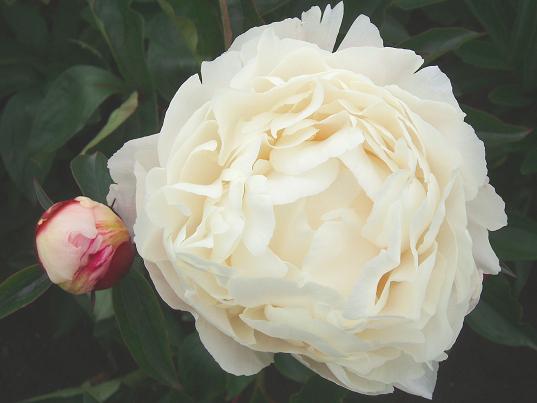
A
peony with a smaller secondary flower which can be removed.
We cut flowers
daily in our nursery. The number of flowers cut will depend on the variety of
peony and weather. Occasionally on very hot days some varieties will flower so profusely that we
will cut flowers in the morning,
afternoon and again in the evening.
Always leave two
stalks on each plant when cutting flowers. These remaining stalks will replenish
the plant’s energy reserves to flower again the year after.
Peonies have few pests or
problems. The most frequently occurring pests are the
fungal diseases; botrytis blight and leaf blotch. Occurring especially during
wet springs, botrytis affects leaves, stems and flowers. Spots appear on leaves,
stems soften and decay, whilst flowers either rot or buds blacken and fail to
open. Immediate removal of infected material and a thorough autumn clean-up are
essential for control.
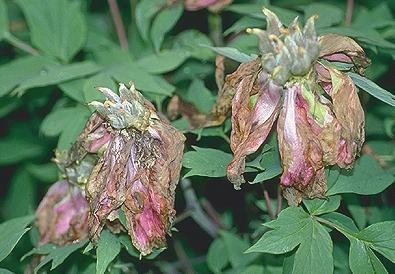
The effects of botrytis on peonies
Leaf blotch develops during warm, moist weather. Dark purple spots form on the
upper surfaces of leaves. Again, removal of infected leaves and thorough autumn
clean-up are necessary for control. Do not water on the leaves.
The soil-borne fungi diseases Phytophthora blight and Verticillium wilt cannot
be cured. Unfortunately, infected plants will have to be destroyed. Do not
replant in diseased soil.
The only insect pests of any consequence on peonies are scales. Scales are seen
on stalks and leaf bases in late summer and over-winter on the below-ground
portion of stalks. For pest control, please check with your local garden center.
The presence of ants on peony blossoms is neither beneficial nor harmful to the
plants--they are simply attracted to the sugary liquid secreted by flower buds.
|